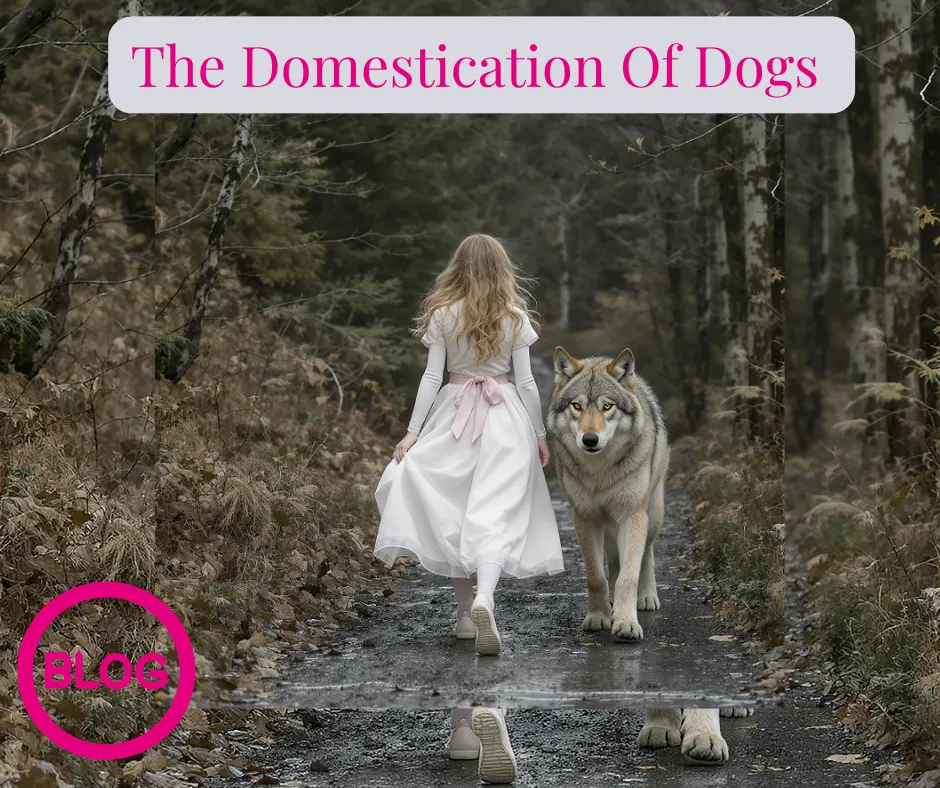
The Domestication Of Dogs
🐺 From Wild Wolf to Lap Dog: Unravelling the History of Canine Domestication 🐾
Have you ever wondered if dogs are man made or a natural species? Read on, and you will find out how wolves turned into the dogs that we see today.
Look at the tiny Chihuahua, the majestic Great Dane, and your fluffy mixed breed. Despite their incredible diversity, every single domestic dog on Earth (**Canis lupus familiaris**) shares an ancestor: the fearsome Grey Wolf (Canis lupus).
The journey from a wild hunter to a beloved companion is one of the most fascinating stories in evolutionary history. It’s a tale that spans tens of thousands of years, making the dog the very first animal species domesticated by humans.
The Great Divergence: How Wolves Became Dogs
When did dogs become domesticated?
We know through genetic analysis that dogs descend from a now extinct species of the grey wolf.
The exact timeline and location are still debated, but the consensus among geneticists and archaeologists is that the split between dogs and their ancestral wolf population occurred somewhere between 15,000 and 30,000 years ago in Eurasia.
Unlike the traditional view of humans actively capturing and taming wolf pups, the more widely accepted theory today is that wolves essentially domesticated themselves.
1. The Scavenger Hypothesis (The First Selection)
This process began at the edges of human settlements
As human hunter-gatherers established semi-permanent camps, they left behind scraps and rubbish which was a reliable, high-calorie food source for the wolves.
This led to the survival of the Friendliest: The boldest, yet least aggressive, wolves were the ones willing to approach this resource. Wolves with a naturally shorter "flight distance" (less prone to running away from humans) were able to linger, scavenge, and survive better than their more fearful counterparts who would not get close enough for the food.
Interestingly, the wolves' genetics, over time, began to shift: These bolder wolves bred with each other, passing on the genes for reduced fear and aggression.
These wolves became tame, and humans utilised their new passive components and bred them to develop a series of desired behaviours to create the dogs that you see today.
2. Mutualism and Selection (The Second Phase)
Once these proto-dogs became accustomed to human presence, the relationship became mutualistic
Human Benefit: Early dogs would have warned settlements of approaching danger (predators or rival groups) and helped clean up camp waste. Later, humans began to actively use the more cooperative canines for hunting and guarding.
The Domestication Syndrome: By selecting for tameness, humans inadvertently selected for other traits known as domestication syndrome—including floppy ears, whiter fur patches, smaller teeth, and the retention of juvenile, puppy-like physical features and behaviours (a process called neoteny).
Dogs were bred to aid humans in everyday life. But as we know now, dogs are mostly pets. Despite their brains being wired to what they were intentionally bred for
From Working Types to Modern Show Breeds
What was the first dog breed?
For thousands of years, dogs were simply categorized by the jobs they performed:
There are seven groups of dogs
Gun dog, hound, pastoral, terrier, toy, utility and working. Many different breeds make up these groups. Find out more here
Each group was bred and developed by humans, selecting the best characteristics of the dogs and breeding with other dogs to create the breeds that we see today.
It isn’t unknown exactly what the 1st breed of dog was, however, the Basenji, Saluki and Greyhound have been depicted in ancient artifacts
The Victorian Breed Explosion 🤯
The incredible diversity of the 300+ standardised breeds we see today is surprisingly recent, mostly developed over the last 150 to 200 years, primarily during the Victorian Era in Britain.
This era saw a shift from breeding for function to breeding for form (appearance) driven by:
1. Dog Shows: The rise of competitive dog shows encouraged breeders to select for specific, exaggerated aesthetic traits like skull shape, coat texture, and tail carriage.
2. Kennel Clubs: Organizations like The Kennel Club established Breed Standards, rigid written descriptions that defined the perfect look for each breed. This forced breeders to practice intensive artificial selection and often close inbreeding to achieve uniformity.
This intense, focused selection is why the genetic difference between a Poodle and a Rottweiler is minute compared to the massive visual difference. They are all still dogs, but human intervention has rapidly amplified specific genes to create the unique "look" of the modern breed.
From a resilient, self-domesticating wolf on the fringes of an ancient camp, we now have a world full of specialized, loving, and diverse companions—all thanks to thousands of years of mutual reliance and a final burst of aesthetic human preference.
Conclusion
This is a stark reminder that the breed of the dog influences how the dog behaves, however, genetics proves that no matter the breed, they all share a common fact that they are all dogs! An XL bully and a Jack Russell are the same. Evolution has changed their appearance, but the brain and instincts are the same.
Nature V Nurture
Rather than competing, genetics (nature) and environment (nurture) work together in complex ways throughout the dog’s life.
Epigenetics
This is the field of study that best illustrates the direct link between the two. Epigenetics shows that environmental factors—like diet, stress, exercise, or early-life adversity—can switch genes on or off without actually changing the underlying DNA sequence. We can change how nature has influenced the behaviour with nurture.
The nature of any animal will not necessarily define how it behaves if there have been other influences in its life. Nurture can negatively and positively impact behaviour.
Both are intertwined and neither will define a specific behaviour. There are many factors to take into consideration when looking at a dogs' behaviour.
I have been told many that large breeds such as XL bullies, Malinois, Rottweilers cannot be trained using food and need a firm hand.
I hope that the information in this blog, opens up your eyes to the nonsense of those statements.
Humans changed the behaviour and appearance of wild grey wolves using food! Therefore, a domesticated dog who is not defined by its breed but by different factors can indeed be trained using force free methods.

